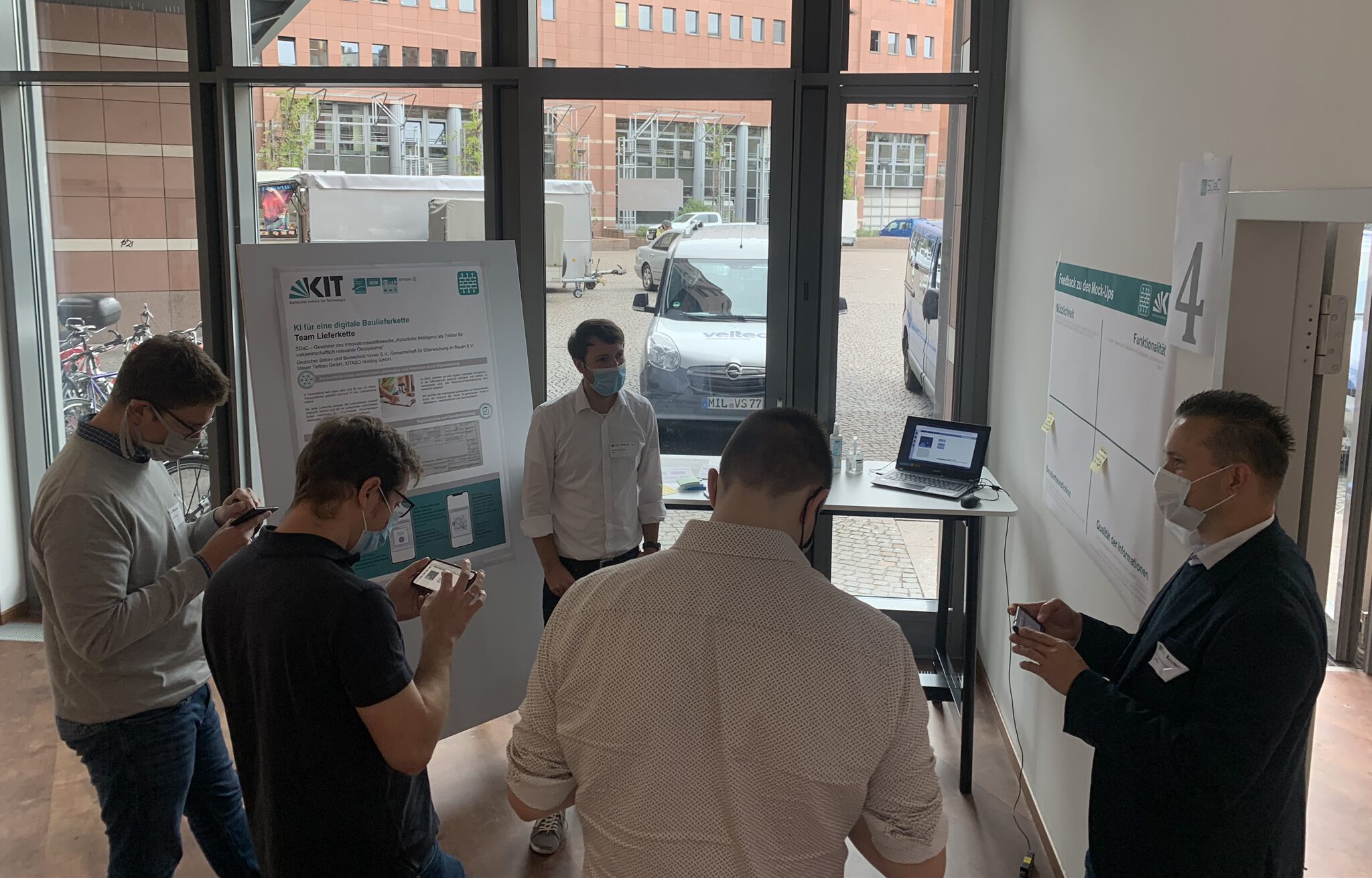
Development of a modular DIN SPEC

Development of a modular DIN SPEC for digitization and standardization of the supply and value chain of building products

Vast quantities of analog delivery bills consume a lot of working time on construction sites due to repetitive documentation activities. The supply chains in construction projects are very complex and fragmented due to the large number of interfaces, the data flow and the amount of data. Due to this high fragmentation, there is currently no digital and generally formulated description of the supply chain for construction products.

The sub-project "Digital Supply Chain for Construction Products" of the joint research project "Smart Design and Construction" (SDaC) pursues the goal of not only digitizing but also unifying and standardizing the heterogeneous supply chains of construction products through the use of an AI-driven platform [1].

It has become apparent that suppliers and construction companies use many heterogeneous data processing systems. One goal of the subproject is to define the interfaces and feature lists as the basis for a generally formulated and accessible digital solution and to convert them into a standard (DIN SPEC). Therefore, DIN SPEC 91454 "Information exchange of the supply and value chain of building products" was initiated in August 2020 within the framework of SDaC [2]. The aim of the DIN SPEC is to leverage the potentials as well as to reduce waste of resources through digitalization, unification and standardization of the heterogeneous supply chain [3]. DIN SPEC 91454 pursues the following three sub-goals:

  • General opportunities for digitizing building product supply chains are described.
  • The interfaces are defined and feature lists are created. The feature lists are to serve as the basis for a generally formulated digital solution or as an AI-usable standard.
  • The requirements for the interfaces are described.

The scope of DIN SPEC in the delivery process is shown in the gray shaded area in Figure 1 [3]. The creation of a common dictionary is indispensable for standardization. In this dictionary, the terms are defined for all actors. In addition, a translation table is created for the exchange of information. This is used to define which information is created by which actor and sent to whom. The goal is to limit the currently prevailing diversity in the naming of attributes to a defined vocabulary.

Figure 1: Overview of relevant roles and their processes [4].

DIN SPEC 91454 was initiated on January 29, 2021. Since then, several meetings have taken place [5]. At one of the first meetings, it was decided to divide DIN SPEC 91454 into three parts (Figure 2):
• DIN SPEC 91454-1 Information exchange of the supply and value chain of building products - Part 1: General process description
• DIN SPEC 91454-2 Information exchange of the supply and value chain of building products - Part 2: Concrete
• DIN SPEC 91454-3 Information exchange of the supply and value chain of construction products - Part 3: Asphalt

Figure 2: Structure of the DIN SPEC 

Part 1 was already adopted at a meeting in October 2021. This basically describes how roles, tasks and processes can be established, assigned and defined in the value chain. This creates the basis for defining the necessary interface information that is exchanged between the parties involved. Part 2 focuses on concrete as a construction product. Following on from this, Part 3 was initiated, which relates to asphalt as a construction product. It is currently planned to adopt Part 2 and Part 3 together in March 2022. The final publication of the three parts is planned directly afterwards.
The high level of interest from the construction industry in this topic confirms the relevance of standardizing and digitizing the exchange of information on construction products. Already during the development phase of the first three parts, representatives from different areas of the construction industry have shown interest in the addition of further construction products. Therefore, arrangements have already been made to include further construction products (e.g. reinforcing steel, precast concrete parts) as new parts of DIN SPEC 91454.

[1] K. Vasilic, „Digitale Lieferkette für Bauprodukte: Das Vorhaben SDaC,“ DBV-Rundschreiben, vol. 267, pp. 10-11, März 2021.
[2] „Geschäftsplan DIN SPEC 91454: Informationsaustausch der Liefer- und Wertschöpfungskette von Bauprodukten.“ https://www.din.de/de/forschung-und-innovation/din-spec/alle-geschaeftsplaene/wdc-beuth:din21:333243274 (accessed 21. Mai, 2021).
[3] K. Vasilic, S. Bilgin, and Ö. Tercan, „Digitale Lieferkette für Bauprodukte: aktuelle Aktivitäten,“ DBV-Rundschreiben, vol. 268, pp. 5-7, Juni 2021.
[4] Wolber, J., Cisterna, D., Tercan, Ö., Meyer, L., Haghsheno, S. & Sievering, C. (2021, 16. September). Concept of a continuous information chain using artificial intelligence methods using the example of the concrete supply chain (S.83–194). Weimar. 6. Internationaler BBB-Kongress. https://publikationen.bibliothek.kit.edu/1000138887
[5] Ö. Tercan, K. Vasilic, and S. Bilgin, „Digitale Lieferkette für Bauprodukte – aktuelle Aktivitäten “ DBV-Rundschreiben, vol. 270, pp. 5-7, Dezember 2021.


AI applications in international comparison

AI applications compared internationally

An analysis of applications of artificial intelligence in the construction industry in international comparison

In an analysis on "Applications of Artificial Intelligence in the Construction Industry in International Comparison", software companies offering AI applications in the construction industry were analyzed. The analysis focuses on 116 software companies in Europe and America (North and South America were grouped).

The analysis shows that most software companies focusing on the construction industry and offering applications with AI technologies are to be found in the USA (see Figure 1). While 50 companies were identified in the USA, Germany follows in second place with 18 companies and England in third place with 17 companies. Due to language barriers, few Asian companies were considered in the study. However, since Asia also plays an important role in AI technologies, this will be the subject of a further study to obtain a complete picture.

Figure 1: Geographical distribution of identified software companies

Beim Vergleich der KI-Anwendungen in den Projektphasen in den zwei Kontinenten Amerika und Europa ließ sich eine identische Verteilung der Anwendungen in den Projektphasen erkennen (siehe Abbildung 2). Beim Vergleich wurde in vier Phasen unterschieden: Baurealisierung, Bauplanung, Baubetrieb und „in allen Phasen“ (Baurealisierung, Bauplanung und Baubetrieb). Die überwiegende Anzahl – mindestens die Hälfte – aller KI-Anwendungen werden sowohl in Europa als auch in Amerika in der Projektphase Baurealisierung angeboten. In der Projektphase Baubetrieb werden in beiden Kontinenten KI-Anwendungen weniger oft angeboten.

Figure 2: Distribution of software companies in project phases America vs. Europe

Wie auch bei der Verteilung der Softwareunternehmen in den unterschiedlichen Projektphasen, liegt auch bei der Verteilung der Softwareunternehmen in KI-Methoden in den Kontinenten Amerika und Europa eine annähernd gleiche Verteilung vor (siehe Abbildung 3). In beiden Kontinenten überwiegt die Methode „Mustererkennung in Daten“ (je 21 Anwendungen), gefolgt von der Methode „Computer Vision“. Dabei wird diese KI-Methode in Europa (17 Anwendungen) öfter angeboten als in Amerika (12 Anwendungen). Die restliche Verteilung der genutzten KI-Methoden bei den angebotenen Anwendungen ist annähernd gleich.

Figure 3: Distribution software companies in AI methods America vs. Europe

The analysis shows that there are already many solutions in the construction industry that rely on AI applications. Within the SDaC research project, we are working together with developers to provide a platform for AI applications to make a key contribution to the digitization of the construction industry.

Object recognition in ground plans

Object recognition in ground plans

Dieser Inhalt wurde auch auf der internationalen Konferenz „AI in AEC“ am 24.03.2021 von Patrick Hemmer (KSRI-KIT) präsentiert.

In recent years, more and more companies in the architecture, engineering and construction industries have become aware of the potential of artificial intelligence (AI) to improve work processes. This trend is being driven by various technological advances, such as the increasing adoption of Building Information Modeling (BIM). To date, however, few medium and large companies have been able to use their data profitably. As in many other industries, employees are uncertain about the impact AI will have on their work and are therefore reluctant to support the upcoming transformation.

Das Konzept der „human-centered artificial intelligence" has become increasingly important in recent years, both in practice and in science. The approach is based on the idea that AI systems should not replace employees but complement and empower them. Especially in the field of architecture, where many work processes are characterized by a large number of repetitive tasks, identifying and assigning these tasks to computers is a promising endeavor. For this reason, it can be assumed that more and more systems based on the combination of human and artificial intelligence will find application in practice in the future.

The process of mass determination requires the manual counting of relevant components. In the area of building operations, the challenge here is to identify objects from floor plans, which are usually only available as rasterized images or printouts (see Figure 1). 

Figure 1: Reduction of manual work through AI applications

To solve this problem and promote quality control, the human-in-the-loop system developed as part of the Smart Design and Construction research project recognizes symbols relevant to users in scanned floor plans to support the design process and simplify matching with building requirements (see Figure 2).

Figure 2: By quantifying prediction uncertainty, the system can communicate to users which symbols need to be verified

Here, a bilateral cooperation between user and system takes place. On the one hand, it supports its users by providing relevant recommendations, but on the other hand, it also offers them the opportunity to contribute their domain knowledge in a targeted manner in order to ultimately contribute to more efficient and reliable mass determination.

In addition to this use case, a large number of development teams are working on solutions for other use cases as part of the research project in order to make a decisive contribution to the digitalization of the construction industry.

A new year - where are we heading?

A new year - where are we heading?

In many studies on artificial intelligence, the construction industry is not listed. The question therefore arises, where does AI stand in construction practice and when will it be used as standard?

Artificial intelligence (AI) applications have become a transformative technology over the past decade and, as a result, are already commonly used in many industries (see Figure 1): leading the way are manufacturing, finance, education, and sales. (Deloitte Research 2019)

Figure 1: Application of AI in various industries (source: Deloitte Research 2019)

Since the construction industry is not listed in the figure, the question arises: where in the figure would one place the construction industry?

Betrachtet man die vier Quadranten in der Abbildung „Transition“, „Developed“, „Germination“ und „Growth“, wäre die Bauwirtschaft nach unserer Meinung in den Startlöchern (Germination) verortet.

Initial applications exist as stand-alone solutions. In a survey conducted at SDaC's third roundtable on Jan. 13, 2021, 197 people participated (see Figure 2). Of these, 48% believe that in less than 5 years AI applications will be used as standard in construction practice. Consequently, more and more AI applications will be piloted and widely applied in construction projects in the coming years.

Figure 2: Results of the survey in the third SDaC RoundTable on the use of AI in construction practice (Source: SDaC).

To get there, Reim et. al (2020) suggests four steps to implementing AI applications in your own organization:

  • Creating an understanding of the potential and challenges of AI in the company.
  • Discussion on changing existing business models and its roles.
  • Alignment of IT strategies with business model strategies, with the aim of promoting new competencies, services and customer segments.
  • Organizational acceptance through pilot projects, the formation of AI teams, training on AI, the development of an appropriate strategy, and internal and external communities for further development.

In order to meet the expectations from Figure 2, there is an increased need for action in construction companies to create an understanding with training and education as well as the transformation of existing structures. 

Where do you see a need for support from, for example, research, policy or consulting? Please feel free to contact us Contact.

These are our goals in 2021:

  • The main functionalities of the platform are realized technically.
  • Initial technical prototypes for the applications will be completed based on the data provided in the consortium.
  • On 23-25.04.2021 our first SDaC Hackathon will take place. Information will follow on our homepage under: https://www.sdac.tech/hackathon. Thus, our goal is to promote innovations for the construction industry.
  • We initiate a DIN Spec for the exchange of information of the supply and value chain of building products.

Sources:

Reim, Wiebke; Åström, Josef; Eriksson, Oliver (2020). Implementation of Artificial Intelligence (AI): A Roadmap for Business Model Innovation. AI 1, no. 2: 180-191. https://doi.org/10.3390/ai1020011

Deloitte (2019). Global artificial intelligence industry whitepaper. https://www2.deloitte.com/cn/en/pages/technology-media-and-telecommunications/articles/global-ai-development-white-paper.html

A guideline for digitization in the construction industry

A guideline for digitization in the construction industry

What potentials result from digitization? What do these potentials look like when several organizations work on the same result? Which measures need to be taken for a step-by-step implementation?

Digital construction networks

An empirical study on the topic "Digital construction networks - an empirical analysis of incoming goods control on construction sites" was conducted.

Several studies are already analyzing what improvements and challenges can be brought through digitization in general (see Telekom 2019/2020). However, how these can be implemented in concrete terms has not yet been sufficiently scientifically examined. Especially when - as in the construction industry - a large number of project participants are involved.

In a particular example - the process of a concrete delivery from order to billing - only 33.33% of the steps on the construction site are value-adding activities. The remaining 66,66% are related to activities that do not add value but are nevertheless necessary. The waste is caused by media breaks and the associated manual processing work.

From the potentials identified in the analysis, measures for digitalization can be derived. The digitalization of data and its interfaces leads directly to improved value creation along the process chains and thus for the entire construction network involved. As a result, a guideline was developed which, by means of a step-by-step action plan, should simplify the implementation towards digitalized incoming goods control. If you are interested in the complete results, please contact us.

Telekom. 2019/2020. „Digitalisierungsindex Mittelstand: Der digitale Status Quo im Deutschen Baugewerbe.“

Man and machine

Why man and machine should work together in the construction industry

Insights into our research

Planning mistakes as motivation

The construction of the new Berlin Airport (BER) and many other prestigious construction projects (e.g. the construction of the Eurotunnel or the Sydney Opera House (Hall 1982)) show that planning mistakes by people often lead to delays in construction projects. Planning mistakes were first scientifically described by Kahneman und Tversky (1977). They show that when planning projects, people tend to underestimate the time needed to successfully complete the project. The consequences of these misconceptions are usually increased costs, longer project lead times and reduced quality.

However, these misjudgements are often not due to the lack of expertise of those responsible. Rather, systemic causes are at work: The highly fragmented construction industry, the increasing complexity of construction projects and their limited time frame, result in a loss of transfer of knowledge and a lack of interfaces. An analytical overview of the project, without bias from previous projects, with constantly changing parameters, represents an enormous challenge for managers. This often results in poor management and bad decisions (Bent Flyvbjerg 2020), which lead to the planning mistakes. According to Kahneman und Tversky (1977). a key lever to counteract this problem is to enable access to distributed information from a variety of projects. 

Due to the complexity of construction projects, many factors can affect decisions that must be documented as information in a project. For example, case studies in the forecast of project duration show that simple models, such as the Bromilowsche model of 1980, are not applicable in construction practice (Magnussen 2006, Flyvbjerg 2002). 

Further research shows that methods of Artificial Intelligence make better predictions because a large number of factors from a variety of projects can be evaluated mechanically (e.g. Petruseva 2012, Dissanayaka 1999, Wei 2006). In diesen Arbeiten wurden vor allem Künstliche Neuronale Netze (KNN) angewendet. KNNs agieren nach dem „black box“-Ansatz. Sie sind nicht „inherent“ für den Menschen verständlich wie z.B. ein Entscheidungsbaum. Offene, transparente „glas box“-Ansätze sind zur nachvollziehbaren Entscheidungsfindung erforderlich.

Man and machine - how good are both in comparison?

In order to compare how well man and machine make decisions, different AI models were trained using a data set. The data set contains 225 projects with five descriptive characteristics in the field of building construction and infrastructure construction (i.e. road, bridge and sewer construction) in New York. Different decision trees (e.g. Random Forest, GBT, catboost) were trained to predict the duration of construction projects and then to evaluate the training model on an unknown test data set. The predictions of the AI models were then compared with the human predicted duration. The following figure shows the comparison. It shows that in most projects the prognosis of the human being was closer to the actual duration than the machine (number of cases). 


The comparison between man and machine in making decisions during the strategic phase of a construction project at a high level of uncertainty shows the advantages of a data-driven analysis of distributive information: Distributive information can be handled and mechanisms of action can be demonstrated transparently and objectively for decision-making. With the addition of further features and a larger project database, the results can be further improved. It can also be assumed that with a decrease in uncertainty and an increase in information within the project, better results can be produced by the machine.

Since humans are the last decision makers and the duration of a construction project is also determined by numerous soft (i.e. non-quantifiable) factors, humans remain essential in relevant decisions. A cooperation between man and machine therefore seems to be very important in the future.

Would the planning of the Berlin airport BER have been better with AI models?

Explanable AI models can support the planning and realization of construction projects, as they can objectively evaluate a large number of parameters from a variety of projects. Risks can thus be analyzed quickly and transparently. 

Since models are trained on the basis of the respective data set and so far there is no database with thousands of documented airport projects worldwide, it is not possible to train a specific airport construction project model. Therefore, the following two questions have to be asked in research:

1. To what extent can identified causal relationships be transferred to projects of a different category, location or size?

2. How do soft factors influence the training of AI models? Examples are trust, acceptance or the collaboration of the project participants. 

Planning errors can also be found in other areas

Erroneous planning is not only to be found when forecasting the duration of major construction projects. Also in other project phases the tasks are still very complex: If individual objects are planned in the construction planning, this can lead to a missing or wrong arrangement. Due to the definition of the bill of quantities, the contract design can contain passages that can be misinterpreted or missing. Or when tracking the progress of construction work, individual elements may be forgotten. 

The machine analysis and comparison of a large number of projects and sections within the project can help to reduce these planning errors. AI models can support people, reduce search times and improve evaluations. Decisions as well as the management of construction projects can ultimately be improved. 

If you have any questions or are interested in the above mentioned contents, please contact svenja.oprach@kit.edu. The results are part of a doctoral thesis at the Institute for Technology and Management in Construction.

1. Network meeting

1st SDaC network meeting

on 08.10. and 09.10.2020.

The two-day network meeting, divided into a consortium meeting and a meeting with our associated partners, served to exchange and debate among our demonstrators.

"We started the project in the middle of the lockdown, which is why it is especially nice to see what the team of the Karlsruhe Institute of Technology (KIT) and the consortium partners have achieved within half a year," says Prof. Dr. Shervin Haghsheno from KIT, who is the scientific director. He is particularly proud that despite the size of the project, a team spirit was quickly established. "I am pleased that all partners are highly motivated to work on the project. This is especially thanks to the project management, which puts a lot of emphasis on teamwork, both on the human and organizational level".

The 1st network meeting served to present the current status of the research project to the associated partners and to discuss the individual use cases. Roland Sitzberger, Partner at Porsche Consulting Construction & Infrastructure, was invited as an associated partner and was pleased to learn what has been done so far. "I consider the exchange with the various parties involved, including their different wishes, suggestions and origins, to be very valuable. This will help us move forward more quickly than if we just look at the individual silos," says Sitzberger.

Also Eric Giese, CTO of digitales bauen GmbH and consortium partner, looks back with satisfaction on the progress of SDaC. "The nice thing about the project is that all players in the construction industry are represented and we can involve them in the research. In addition, we can take care of the business models relatively early on, which gives us an advantage over other research projects. And today we have received important feedback to find out whether we are on the right track". 

After the meeting, it is now time to move on to the next major goal. "Now we want to complete the phase of understanding the needs in terms of our use cases. We want to know specifically what the user's needs are, so that we can start developing prototypes at the beginning of 2021," says Prof. Dr. Shervin Haghsheno.

KI & Drohnen in der Baurealisierung

AI and drones in construction

Photogrammetry using drones to create intelligent 3D models

Using drones on construction sites for construction progress documentation, surveying, mapping and inspection of hard-to-reach areas

Driven by the rapid spread of smartphone technology in recent years, drone technology has also developed dramatically. A variety of smartphone components and sensors, such as gyroscope, lithium-ion battery, camera sensors and many more are also used in commercial drones or multicopters, as they are also called.

The existing drone technology has already reached a stage where it is well suited for use on construction sites with minor adjustments to the software. Possibilities for the use of drones on construction sites include construction progress documentation, surveying and mapping, viewing of hard-to-reach areas.

The challenge in the deployment of drones is to select the appropriate systems from drones hardware, software and data-analytical tools for the respective application. Artificial intelligence plays a decisive role in this process in order to be able to draw the right conclusions from the often huge amounts of data.

AI for converting image data into intelligent 3D models

Ein Beispiel bei der künstliche Intelligenz bereits heute auf der Baustelle zum Einsatz kommt, ist die digitale Erstellung von Dach- und Fassadenvermessungen. Hier hilft die KI um aus Bilddaten, intelligente 3D Modelle zu erstellen, die standardisiert vermessen werden können. Wie das funktioniert ist in den folgenden drei Schritten zu sehen:

  1. On site, a drone is used to capture images of the building:
2. Using photogrammetry algorithms to create a 3D model:
3. Using edge detection and semantic analysis to create an intelligent 3D CAD model:

On the basis of the 3D CAD model, measurements can be taken, construction-related changes can be made, target/actual comparisons can be made and much more. The intelligent 3D model provides the basis for all project participants to exchange information about the project on a uniform database.

Through the appropriate combination of drones and modern AI methods, workers on the construction site can be supported, processes accelerated and risks on the construction site reduced.

Within the framework of Smart Design and Construction, the project team is working on developing a variety of additional applications for construction companies resulting from the combination of AI & drones.

3, 2, 1… und Start

3, 2, 1 … und Start

Yesterday on April 01, 2020 our research project has officially started!

Yesterday was finally the big day: Our official project start! In the next three years we will work on the development of an AI platform for the ecosystem construction industry and implement eight assistance systems. These assistance systems range from building design, construction planning, supply chain management and construction realization.

Nicht nur ausschließlich aufgrund der aktuellen Situation nutzen wir digitale Medien zur Kooperation zwischen den Konsortialpartnern. Vielmehr aufgrund der geographischen
Verteilung über Deutschland (Karlsruhe, Stuttgart, Bielefeld, Dortmund, Berlin und Augsburg), sind wir auf digitale Meetings, eine Dokumentenmanagementplattform und eine Kommunikationsplattform angewiesen.

Today more than 20 people attended a first MS Teams appointment to officially start the project. We are all very motivated!

In the next few weeks we will sort and structure the work packages for this year. One of the first steps will be a detailed analysis of the user requirements. Thus, we want to achieve the challenging goal of first prototypes until end of this year.  


For more frequent updates follow us on our social media accounts.   

The first week of three exciting years just started!

Together we will shape the transformation of the industry!

#ReducingComplexity #AI #ArtificialIntelligence #Platform #Digital #Construction #KIT #Airteam #Cyberforum #DBV #DigitalesBauen #DIN #FARO #Fraunhofer #Goldbeck #GÜB #IGP #Metis #Xitaso

#Thanks2BMWi #Thanks2DLR